
Case Studies
Date
Reading time
5 Min
Author
A Client Success Story
One of Austria’s largest public institutions - a major utility group responsible for critical infrastructure serving millions - needed to modernize its documentation of executive board meetings.
The challenge: their discussions involve sensitive M&A strategy, regulatory negotiations, and personnel decisions. This information cannot be sent to cloud AI services. But manual documentation couldn’t keep pace with their needs.
They asked us a simple question:
Can we have sophisticated AI without compromising data sovereignty?
The Situation
Our client’s executive board meets regularly to make decisions affecting billions in assets and millions of citizens. Each meeting generates hours of discussion that must be accurately documented for regulatory compliance and corporate governance.
Like many organizations, they saw the potential of AI-powered transcription and summarization. The technology promised to transform hours of audio into structured documentation in minutes. But there was a constraint:
For regulatory and compliance reasons, using cloud-based AI services wasn’t an option.
They faced what seemed like an impossible choice:
Cloud AI services — Fast and capable, but data flows through external servers
Manual transcription — Secure but slow, expensive, and prone to inconsistency
Basic on-premise tools — Private but lacking the sophistication they needed
None of these options worked. They needed something that didn’t exist yet: enterprise-grade AI that runs entirely offline.
What We Discovered
When we began adapting the system to this specific use case, we found that standard AI transcription models could produce acceptable verbatim transcripts.
But generating formal meeting protocols—the official documentation of decisions and discussions—proved far more challenging.
Standard, out-of-the-box approaches got decisions wrong.
Not occasionally. Systematically.
In our initial assessment, roughly:
1 out of 6 board decisions was documented incorrectly by off-the-shelf, offline AI approaches.
“Approved” became “deferred.”
“Rejected” became “tabled for further discussion.”
Discussions were attributed to the wrong participants.
For a public institution with strict governance requirements, this wasn’t a minor issue.
Incorrect documentation:
Creates compliance liability
Undermines the legal standing of board resolutions
Is simply unacceptable
The Insight That Changed Our Approach
The problem wasn’t model quality. Modern large language models (LLMs) are remarkably capable. The problem was that the AI lacked what human scribes accumulate over years: domain expertise.
Understanding:
How approvals work in this organization
The difference between informal agreement and formal decision
The language conventions of Austrian corporate governance
Our Approach
We didn’t search for a better model. Instead, we built a system that combines AI capabilities with encoded domain expertise—and makes certain types of errors structurally impossible.
Principle 1: Grounded Generation
LLMs can hallucinate—generate plausible-sounding content that isn’t supported by the source material. In meeting protocols, this is dangerous. Our solution: Every statement in the generated protocol must include a verbatim quote from the transcript as evidence. No evidence → No statement.
Principle 2: Encoded Domain Expertise
Rather than hoping the AI would learn protocol conventions from examples, we worked with the client to encode their specific rules as deterministic logic:
How approvals are formally documented
What language indicates a decision vs. discussion
When informal consensus becomes official resolution
These rules now guide the AI’s output.
Principle 3: Systematic Validation
We established rigorous evaluation against human-written reference protocols. Not a one-time test — a continuous feedback loop:
Every improvement was measured
Every failure was analyzed and addressed
The Results
Through iterative refinement guided by these principles, we achieved what initially seemed impossible:
Decision accuracy improved from 83% to 100%.
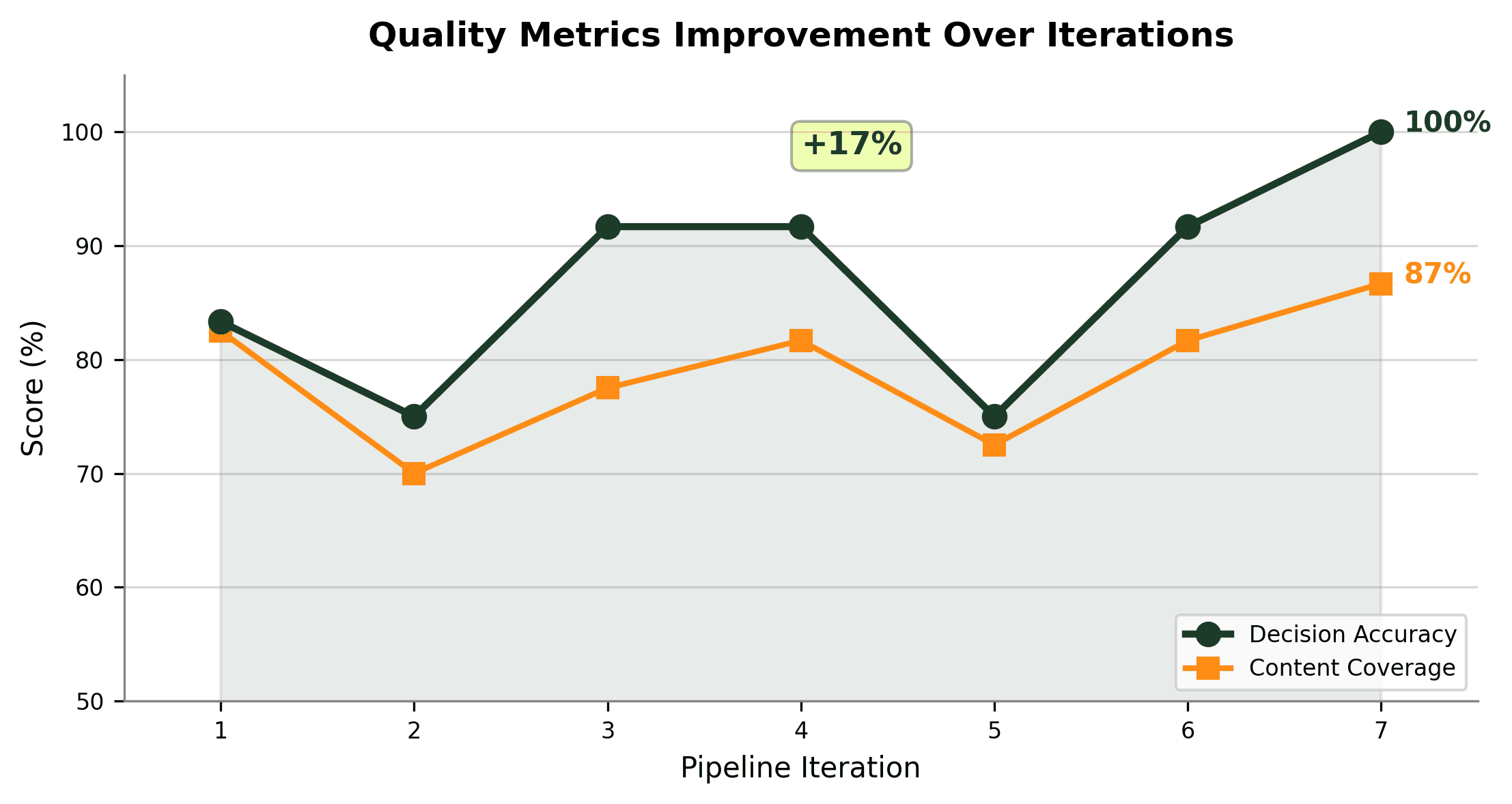
Every board decision—approval, rejection, deferral, delegation—documented correctly.
Validated against human-written protocols across multiple board meetings.
100% decision accuracy. Every board decision—approval, rejection, deferral, delegation—documented correctly. Validated against human-written protocols across multiple board meetings.
Complete data sovereignty. The entire system runs on the client's infrastructure. No cloud APIs. No external data transmission. Meeting audio never leaves their network.
Same-day turnaround. What previously took days of manual work now happens in hours. Board meetings can be documented and distributed the same day.
The Takeaway
This project demonstrated something important: Privacy and sophisticated AI are not mutually exclusive.
The common assumption is that you must choose:
The common assumption is that you must choose—either you get powerful AI capabilities by sending data to cloud services, or you maintain data sovereignty by accepting limited functionality. This is a false choice.
With careful architecture—grounded generation to prevent hallucination, encoded domain expertise to capture institutional knowledge, and systematic validation to ensure reliability—it's possible to deploy enterprise-grade generative AI while maintaining complete control over sensitive data — it’s possible to deploy enterprise-grade generative AI while maintaining complete control over sensitive data.
“The key wasn’t finding a more powerful model. It was building a system that combines engineering and AI capabilities with the domain expertise that makes the difference between ‘impressive demo’ and ‘production-ready tool’.”
This approach applies wherever high-stakes decisions require both AI capabilities and absolute data control:
Healthcare — Patient case discussions requiring privacy compliance
Legal — Attorney-client privileged strategy sessions
Finance — Investment committee meetings with regulatory requirements
Government — Classified briefings and sensitive policy discussions